

Bush, Cheney legacy
G W Bush is now officially out of office. Heard an interesting take on the Bush years - I think this was on NPR. Essentially, the claim was that Cheney was pushing policy during the first 1/2 of the 8 years Bush was in office. [Cheney, btw, in my opinion, was nuts. In a position such as VP of the US, this is a dangerous thing.] Bush deferred to Cheney time and time again during those years.
Bush finally started distancing himself from Cheney when Cheney was pushing for some highly suspect program that was, in the mind of a dozen or so top Justice dept officials, clearly illegal. The program almost went through, but when these officials threatened a mass resignation in protest, then finally at this 11th hour Bush saw the light and pulled the plug on the program (actually - he insisted that its authors go back to reformulate it in a more legal manner - whether they succeeded is an entirely different matter)
I will attempt to find some info on this ... OK, found it. Written by Barton Gellman in the Washington Post, Sept 14, 2008:
http://www.washingtonpost.com/wp-dyn/content/article/2008/09/14/AR2008091401974_pf.html
Near the end of the article appears this quote:
"In the aftermath, the White House senior staff asked questions. Was the president getting timely information and advice? Had he relinquished too much control to Cheney?
"Bush, aides said, learned something he would not forget. Cheney was the nearest thing to an anti-politician in elected office. Bush could not afford to be like that. In his second term, his second chance, the president would take greater care to consult his own instincts."
posted by -bb @ 2:21 AM
0 comments

76 Responses to “Black holes from the LHC could survive for minutes”
By Howard Morton on Jan 23, 2009 | Reply
Oops! Shouldn’t we consider a return to the drawing board?
By Dave on Jan 23, 2009 | Reply
Wouldn’t it depend on the event frequency? The analysis doesn’t seem to address individual black holes combining (which over a lifetime of 100 seconds, seems like a reasonable thing to look at). If the LHC can’t make more than one every 100 seconds, we’re presumably safe.
By Jacques on Jan 23, 2009 | Reply
My real concern is, could it gobble up what remains of my 401(k)?
By Geoffrey A. Landis on Jan 23, 2009 | Reply
Jeez– read the abstract. It’s a calculation based on a theoretical model using some very speculative physics for which there is NO EVIDENCE WHATSOEVER. Really. Ignore it.
The main thing to keep in mind is, cosmic rays have energies vastly higher than the LHC. If the LHC could produce black holes, then there would be black holes floating around everywhere.
By Gp on Jan 23, 2009 | Reply
Further to Geoffrey’s point. Wouldn’t the sun have become a black hole already if it were that easy to create one? Although, I am not a philosoph… err not a scientist.
By Dave Mishem on Jan 23, 2009 | Reply
Almost every single new technology has had unexpected side effects. Look at what happened to the early X-ray pioneers. The smart way to do high energy physics research is on the moon, preferably the dark side. We still don’t understand how physics works - how can you possibly say that doing X, Y, and Z won’t lead to the creation of a new elementary particle A with properties never seen before?
By Jonathan on Jan 23, 2009 | Reply
Did anyone see that movie ‘event horizon’? The black hole took the guy into a dimension of pure evil. That kind of thing happens in real life. I am scared!
By Peter Yachnin on Jan 23, 2009 | Reply
Maybe this would be a good time to ponder this
http://en.wikipedia.org/wiki/Precautionary_principle
By Tim Boynton on Jan 23, 2009 | Reply
I wonder how many black holes we can observe were created by civilizations that did not believe it would end their existance ? If it all goes wrong someone, somewhere will see the sudden start another one. I feel the existance of the many seems to out weigh the science of the few.
By Barry Kumnick on Jan 23, 2009 | Reply
Don’t create black holes. The current theory of what powers them is incorrect.
The true source of a black holes gravitational energy isn’t the mass that gets sucked into it. That mass gets destroyed in the singularity. So does the energy it is composed of. It gets destroyed when the gravitational force that sucks it in makes it exceed the speed of light because exceeding the speed of light in space destroys the representation of the Dirac Sea; i.e., it destroys light, energy, matter, and spacetime. The singularity inside a black hole is the only thing that violates the conservation of energy. There is a universal law more powerful than the conservation of energy. That is the conservation of nonexistence. Nonexistence cannot be destroyed because it is nonexistent. It is the lack of existence. The conservation of nonexistence is the first cause of symmetry. It is the cause of dark energy and the cause of the Dirac Sea.
Inside the event horizon of a black hole lies nonexistence. No Dirac Sea. No energy. No space. No time. No dimensions. Black holes are powered by the dark energy difference between the nonexistence inside the black hole and normal space outside it. If you don’t know this, there is a finite chance you could destroy the earth. The energy of the Dirac Sea outside the black hole is inexhaustable. It is the most powerful energy source in the universe. We don’t know how to contain it.
As far as cosmic rays, the creation of a black hole involves more than energy. The thing that actually triggers the creation of a black hole is energy being forced to exceed the speed of light in free space. Cosmic rays don’t do that, unless they get sucked into a black hole.
This is based on research still to be published. Ignore at your peril.
By Doubt on Jan 23, 2009 | Reply
This is starting to get me nervous.
This is orders of magnitude from what initially stated, and we certainly do not know enough in order to know that the equations will hold or that other factors may affect the process.
Furthermore it would seem simple to facilitate initial accretion, particularly in the case of those long lived black holes…
By Johan Louwers on Jan 23, 2009 | Reply
Well, one good thing… if they are wrong nobody will blame them… if the calculations turn out to be wrong we will all be gone and they will not have to apologize for the incorrect calculations.
regards,
Johan Louwers.
By jake on Jan 23, 2009 | Reply
There’s an old theory that states that civilizations advance to the point where they discover nuclear weapons, then they proceed to destroy themselves.
I would like to amend this to civilizations advance to the point where they can build a Large Hadron Collider…
By Doubt on Jan 23, 2009 | Reply
I’m getting the feeling that there’s a anti-anti-science knee jerk reaction going around. People embrace a set of conclusions while waving away an opposing set just because it’s mostly speculative. Just like the former conclusions. And why is the context being outright ignored? As far as I can tell the solar system is not a LHC.
“11pm Galactic News: If you put your credits on black holes call your bookies now and you will be in for a treat! The budding civilization at Sol III has managed to wipe itself out with the good old energy collider. Last transmissions captured seem to be of someone complaining of not even going to have sticks left.”
By Carl Antone on Jan 23, 2009 | Reply
Show me a gravitron first. Then maybe I’ll believe you.
By Ralf-Peter on Jan 23, 2009 | Reply
Wow that would be great. We could create small black holes, feed them with a particle beam, and achieve 100% matter->energy conversion.
If they are created, they clearly can’t be hazardous, since they must be created in the upper atmosphere as well.
By Stephen D Covey on Jan 23, 2009 | Reply
No need to worry - the existence of neutron stars proves that cosmic rays (some of which have much higher energy than the LHC), even when striking a surface with extremely high density, cannot create black holes that could threaten the Earth.
If it was even remotely possible, those neutron stars would have turned into black holes long ago, and we would not see any.
I am still, however, in favor of that large accelerator on the far side of the moon!
By GreenAvenger on Jan 23, 2009 | Reply
Isn’t the LHC in Europe? As long as it doesn’t suck up the USA, I’m fine with it.
By Ken Cox on Jan 23, 2009 | Reply
Nature hurls cosmic rays toward the Earth with far more energy than the LHC could ever produce. We most likely have mini-black holes produced by Nature at far greater frequency than one every 100 seconds. Cosmic rays have collided with Earth’s matter for quite a long time, yet we are still here! The wonderful opportunity we now have is the ability to study them in a laboratory environment.
By David Hill on Jan 23, 2009 | Reply
Well, it is certainly a more high tech approach to the EOW than a flood and a boatload of animals and people that survive
By banned digger on Jan 23, 2009 | Reply
in my experience, black holes have always been a lot more pleasurable than white holes.
…just an observation
By Barry Kumnick on Jan 23, 2009 | Reply
The true cause of black holes is an attempted violation of the conservation of nonexistence that nature can’t correct in any other way; e.g., through the release of other forms of energy. Nonexistence cannot be destroyed, because there is nothing to destroy. The conservation of nonexistence is absolute. It is the first cause of symmetry. It is the reason symmetry exists. The universal function that creates the future from the past and drives the evolution of the universe is based on the conservation of nonexistence.
In addition to creating a black hole via a gravitational field forcing energy to exceed the speed of light in free space, one can be created by creating so much assymetry in a high energy particle collision for so short a duration that nonexistence can only be conserved by forcing the energy in the collision past the speed of light. Doing so destroys the energy, thereby conserving nonexistence. However, in destroying the energy, it creates a hole in the Dirac Sea, i.e., it destroys spacetime and everything it contains in the localized region that exceeded the speed of light. A black holes energy is powered by the dark energy differential between nonexistence inside the event horizon and normal space outside it. The dark energy in the Dirac Sea outside the black hole is finite, but extremely large. In other words, the power that drives a black hole is not solely based on the energy that went into the collision that creates it. That is only the trigger. I know, there will be objections that this would violate the conservation of energy. How do you know the conservation of energy isn’t violated inside the singularity in a black hole?
As the amount of assymetry in a collision increases and the amount of time available to discharge the assymetry decreases toward the Planck time, the frequency of the energy released and its power will increase explosively. If we are lucky, the explosive increase in energy will result in a high intensity gamma ray burst that will destroy the LHC before it can create a black hole.
By Toad on Jan 23, 2009 | Reply
DO YOU SEE!? DOOOO YOOOOUUUU SEEEEEE!!!????
By phunk on Jan 23, 2009 | Reply
The thing is, even if they lasted for days or years, black holes that size have such miniscule gravity that they only eat when they directly impact another subatomic particle. That will happen so rarely that they simply won’t grow unless they can survive for millions of years.
By peezawaki on Jan 23, 2009 | Reply
Okay okay, then if cosmic rays collide with Earth and for sure they produce mini-black holes, why not to put the detectors in the space? At least they have the particles accelerated for free by the Sun!
Anyway if anyday we’re spaghettified I hope that thing get sucked me so fast I don’t take care of it.
Btw in answer to GreenAvenger, yeah, is here in Europe, but if we’re sucked it will have enough mass to suck USA too
By Barry Kumnick on Jan 23, 2009 | Reply
It is not purely a matter of energy. Its a matter of too much assymetry being created in too short a time to discharge it as energy without exceeding the speed of light. Cosmic rays are not equivalent to the LHC. LHC does not equal cosmic ray. Cosmic ray density is not high enough to create enough assymetry to trigger the creation of a black hole. I’m not so sure about the LHC.
By Ed Pell on Jan 23, 2009 | Reply
The difference is that black holes produced by cosmic rays are moving at about the speed of light with respect to the Earth, but black holes produced by the LHC can be standing still or slowly moving through the Earth.
By Dave on Jan 23, 2009 | Reply
@people who raised the cosmic-ray objection:
Did that analysis take into account the interactions of concurrent events? That is to say, the idea is in the long long history of the planet, enough cosmic rays have hit the atmosphere that some meaningful number of them must have been at or above LHC energy - and since we’re still here, such collisions must not produce planet-killing black holes. But what about a bunch of similar-energy collisions all in the same place in quick succession - what are the chances of two or more non-PK black holes merging and crossing that line? Have enough CR events happened to establish that scenario as “safe enough” also?
Understand me - my default assumption here is that this has been covered by someone…I just want to know the details.
By James L. Carroll on Jan 23, 2009 | Reply
On the one hand: I agree that when we don’t know what will happen, and if there is even the smallest chance of catastrophic consequences, then we shouldn’t do it, just to be safe. Clearly the changes in estimates indicate that we really have no clue what will happen.
However, on the other hand: in this case, we are replicating a natural phenomenon (the smashing together of cosmic rays at high energy) in order to study it. Naturally, we don’t know what will happen, or we wouldn’t need to do the experiment. What we do know is that whatever happens, it won’t destroy the world, because the world would already have been destroyed, since this happens in nature all the time.
In the end, the precautionary principle does not apply to duplicating natural phenomenon.
By Nick on Jan 23, 2009 | Reply
Ah, a good ol fashioned American response.
By Matthew Strebe on Jan 23, 2009 | Reply
So Barry, how does non-existence have the gravity required to sustain the black hole? If black holes are truly nothing, then they obviously don’t have mass and therefore cannot have gravity. Incogito ergo no sum.
By Cunamara on Jan 23, 2009 | Reply
“This is based on research still to be published. Ignore at your peril.” Jeez, Barry, if the research doesn’t pass peer-reviewed muster then it’s likely to be crackpot stuff. The only peril in ignoring crackpots is when they become homicidal in their frustration.
By Captain Piccard on Jan 23, 2009 | Reply
…but Scotty… what about the space-time continuum?
By Zephir on Jan 23, 2009 | Reply
By my opinion the risk of BH swallowing the planet is rather low due the high activation energy required - but the risk of strangelet formation is quite high - simply because we observed it already!
The muons formation during recent Tevatron experiments in Fermilab well outside of collider pipe may be related to recent pentaquark and tetraneutron evidence and it can demonstrate the stabilization of large matter clusters via supersymmetry and the danger of strangelet formation.
We can understand the dark matter, WIMPS and supersymmetric bosons as a surface tension effects of gravitational field. At the case of large distances / energy densities the energy density of space-time curvature near large particle or galactic clusters can become a dominant force, because it manifests itself as a additional mass density of vacuum with antigravity effects.
In particular, the formation of tiny dense particle clusters can stabilize the exotic forms of matter due the hydrostatic pressure inside of tiny particle droplets like the neutrons inside of neutron stars or atom nuclei by such way, these droplets can escape from collider pipe and they can start the avalanche conversion of normal matter to another strangelets under development of giant explosion, which could vaporize a substantial portion of Earth.
Therefore the latests Fermilab results should serve as a very last warning of people before high energy LHC experiments planned. The confirmation of supersymmetry could become a supersymmetric event for science as well: the best triumph of mainstream science and it’s very last mistake at the same moment.
By Matson on Jan 23, 2009 | Reply
Looking at the numbers, we would expect to find many more intelligent civilizations creating radio sinnals.
It is entirely possible that the obvious steps in scientific discovery may cause intelligent societies to destroy themselves.
It would provide a clear resolution to the Fermi paradox:
http://en.wikipedia.org/wiki/Fermi_paradox#It_is_the_nature_of_intelligent_life_to_destroy_itself
By Eman on Jan 23, 2009 | Reply
If the LHC did create small black holes. Couldn’t you accelerate the black holes’ evaporation by feeding it a stream of antimatter particles? Isn’t that how Hawking radiation evaporates black holes?
I’m pro science and research, but I’m also pro caution when necessary. Maybe some laymen explanations are in order here. How do I get a good laymen explanation and avoid confusing quackery? Quality explanations are always appreciated…
By Kyle Lahnakoski on Jan 23, 2009 | Reply
“we certainly do not know enough in order to know that the equations will hold or that other factors may affect the process”
I suggest using the LHC, and perform some experiments.
By George N on Jan 23, 2009 | Reply
We know for a *fact* that the earth will not be destroyed because John Titor came back from the year 2036 and reported that the LHC *did* produce black holes, but that we were able to trap and control them. That’s how GE built the time machine he used.
Look it up.
By Jayesh on Jan 23, 2009 | Reply
> I wonder how many black holes we can observe were created by civilizations that did not believe it would end their existance ?
Maybe that’s why we see >0 number of blackholes, but 0 alien spaceships
By iain on Jan 23, 2009 | Reply
“…The smart way to do high energy physics research is on the moon, preferably the dark side….”
Great idea. I can just see it now:
“Oh, Honey, there’s a Full Black Hole out tonight!!! it’s SOO romant-” -GIANT SUCKING SOUND-
By tomstatham on Jan 23, 2009 | Reply
I don’t believe this would destroy the earth. The first thing destroyed would be the LHC itself. As soon as it becomes damaged, it will cease to funtion and stop generating these black holes.
–TomS
By j713.9534 on Jan 23, 2009 | Reply
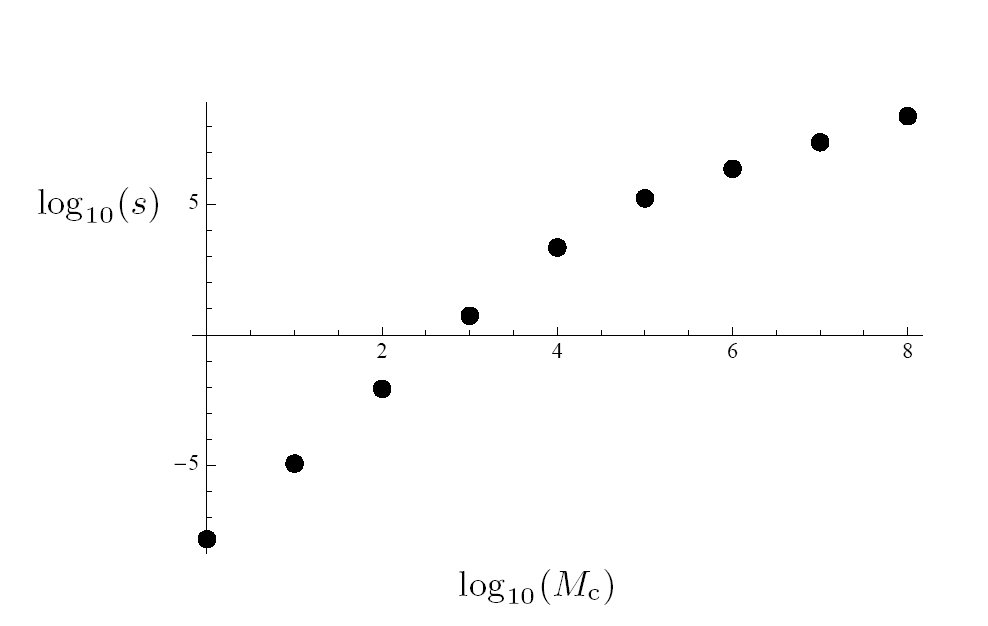
just read the paper. basically then length that these black holes last depends on the length scale at which newton’s gravity fails and gives over to higher-dimensional gravity theories. based the current experiments the paper states in the conclusion the BH is unlikely to grow. Only if we assume systemic errors and one sided errors is it possible for BH to grow at all.
the relevant paragraph quoted below:
“As shown in the previous Section, in particular in Tables
I–III, the maximum black hole mass never reaches
catastrophic size before leaving the Earth. The black hole
mass remains at microscopic values for a wide range of acceptable
initial conditions and for a wide range of critical
masses, Mc. Indeed, in order for the black holes created
at the LHC to grow at all, the critical mass should be
Mc & 105 kg. This value is rather close to the maximum
compatible with experimental test of Newton’s law, that
is Mc ≃ 106 kg (which we further relaxed to Mc = 108 kg
in our analysis). For smaller values of Mc, the black holes
cannot accrete fast enough to overcome the decay rate.
Furthermore, the larger Mc is taken to be, the longer a
black hole takes to reach its maximum value and the less
time it remains near its maximum value before exiting
the Earth.”
By Barry Kumnick on Jan 23, 2009 | Reply
<>
Nonexistence means literally that. No Dirac Sea. No spacetime. No energy. No light. No matter inside the event horizon. The energy is in the spectral energy density of the Dirac sea in the normal space OUTSIDE the black hole. The energy differential between the zero energy density inside the black hole and the spectral energy of the Dirac sea outside means the spectral energy density of the spacetime outside the black hole will be drawn into the black hole like water down a drain. The black hole will draw spacetime, energy and matter into it due to the difference between the nonexistent spectral energy density inside and the spectral energy density of the Dirac Sea of the space outside. Spacetime itself will curve around the event horizon of the black hole as it gets drawn into the black hole. We interpret this spatial curvature as the gravity caused by the black hole.
By marcello on Jan 23, 2009 | Reply
Nonsense. to the particles colliding it makes not a dang bit of difference whether one is sitting still or they are moving towards each other. basic physics 001.
This is getting well beyond ridiculous. This author does NOT represent all physicists, his theories and all those predicting micro-black holes are waaay beyond speculative, and cosmic rays of much much higher energies have been bombarding earth with PRECISELY the same reaction as the LHC for billions of years.
nothing to see here, please move on. There are MUCH more pressing things to worry about. like your money, and your job.
By Barry Kumnick on Jan 23, 2009 | Reply
The only problem in ignoring crackpots is if they turn out to be right.
By Bad Brad on Jan 23, 2009 | Reply
Comic rays are not protons. Its said that cosmic rays have more energy, but protons have a LOT more mass, and if they are travelling at 99.999% the SOL, its hard to imagine that cosmic rays are weaker and, two, what if they create a black hole and then pump a bunch more protons into to … and it grows .. and grows.
My question is this: has anyone explained gama-ray bursts yet? The most powerfull explosions known yet no two are alike? Is that because they are created by black holes eating planets and solor systems?
Great .. I’m applying for an extension …
By devicerandom on Jan 23, 2009 | Reply
The only problem in ignoring crackpots is if they turn out to be right.
Publish your papers in “Physical Review Letters” and we’ll think about that possibility.
By K on Jan 23, 2009 | Reply
That’s what I asked and CERN never replied. My question was: “Is it possible that some of these black might coalesce and form larger black holes? larger black holes would be more powerful than their predecessors and possibly aquire more mass and grow still larger.”
However cosmic rays have more energy and there hasn’t been any incidents with them has there?
By donny on Jan 23, 2009 | Reply
“Nonsense. to the particles colliding it makes not a dang bit of difference whether one is sitting still or they are moving towards each other. basic physics 001.”
Better take a refresher… it’s all about
conservation of momentum which is why there
are counter rotating rings.
Also…
“Its said that cosmic rays have more energy, but protons have a LOT more mass”
Cosmic rays, the really powerful and
damaging ones (though much more rare) are
relativistic Fe56 … 56X the mass of protons.
(core of stars, thrown off after super nova)
However they are not involved with head
on collisions with each other… they
typically follow the earth magnetic field
lines which is why they are more abundant
over the poles (higher dose of radiation
when you have a high inclination polar
flight)
By Barry Kumnick on Jan 23, 2009 | Reply
There is no difference between a cosmic ray colliding with a particle in the atmosphere, and the collision of two particles in a collider - except that in the collider, many particles collide in a small volume of space in a short time. There is a lot more assymetry in multiple concurrent or near concurrent collisions in a small spatial volume than there are in a 2 particle collision scenario like that involving cosmic rays.
Anyway, physicists will ramp up the energy in the collider gradually.
If black holes are formed, which itself is speculative, prior to black hole production there should be some warning in the form of an unexpectedly rapid increase in the energy density released from the collision. That should provide sufficient warning of impending black hole formation to alert physicists to a problem.
By Barry Kumnick on Jan 23, 2009 | Reply
Okay.
By SW VandeCarr on Jan 23, 2009 | Reply
With atom bomb in 1945, they only worried that the atmosphere might catch fire. Look at how much we’ve progressed!
By R.. Mirman on Jan 23, 2009 | Reply
The Warped Brane-World is nonsense. See proof that a universe is possible only with dimension 3+1 (which actually agrees with reality!) in book
Our Almost Impossible Universe:
Why the laws of nature make the existence of humans extraordinarily unlikely
By relaxed on Jan 23, 2009 | Reply
thankfully, none of you sound like legitimate scientists. let’s leave it to the experts please and avoid this senseless speculation.
By John Smith on Jan 23, 2009 | Reply
I think that we should let scientists at LHC, whose whole livelihood depends on continuing this project, make all analyses and determinations as to whether we go ahead with the project.
By John Smith on Jan 23, 2009 | Reply
This is the first reassuring thing in regard to this I’ve heard yet.
By arant on Jan 23, 2009 | Reply
It only takes one…
By luis sancho on Jan 24, 2009 | Reply
kids on the block, a black hole that has eaten the moon will produce exa ct background radiation at 2.7k totally indistinguisahble from the radiation of the so-called big bang, thus it is self evident that being the moon the most common planetoid, and the background radiation the most common radiation and the black hole moon MACHO the only one that can produce it, many moons bombarded by cosmic rays are becoming black holes. Further on, cosmic rays have nothing to do with what CERN will do, deconfine large hadrons, extracting its quarks and massing them together through stockastic cooling in big lumps. According to chen from the institute of physics of china, 10,000 deconfined quarks will form ice-9, the seed of a quark star. CERN will produce one million a second. CHances are thus very big that we become a black hole or a quark star. So who is going to stop this madness? They have inmunity in court. We lost our suit against them for lack of jurisdiction. We need political help if not military. if not as they say in spanglish, good luck y buena muerte
By Georgio Cypriano on Jan 24, 2009 | Reply
The black hole will eat the CERN scientist first……OMG. Being in love with the monster is not all that brilliant…and scientific!.
By Hassan Bin Sober on Jan 24, 2009 | Reply
If events at the LHC swallow Switzerland, what are we going to do without wrist watches and chocolate?
By Lucas on Jan 24, 2009 | Reply
Actually I think it would be amazing that black holes could exist for some appreciable length, because then we could study them in a controlled environment, and how could would that be?
As for whether it is hazardous, I don’t think that it could be as bad as testing nuclear bombs out in the open and letting the wind carry away the waste.
By Lucas on Jan 24, 2009 | Reply
might you explain what a quark star is, in all my astronomy and cosmology courses I’ve never heard about one, though I have wondered if there might be a degeneracy level below neutron, but the difference between something like that and a point source black hole has no difference.
So my questions are, what are you saying? and where did you come up with this nonsense?
By equinox on Jan 24, 2009 | Reply
I havn’t bothered to read many replies, but would just like to say… When are these “scientists” going to accept that we exist in an electric universe ?
Black holes have never been proven to exist and they cannot be created quite simply because black holes DON’T EXIST !
By Dear Barry Kumnick, on Jan 24, 2009 | Reply
>”This is based on research still to be published.”
Research done on the inside of your own closed eyelids during an acid trip doesn’t count, dude.
By Malacay on Jan 24, 2009 | Reply
We still dont know how many Dimensions really exist. Bumbleebees can fly although they shouldn’t be able to acording to current physical laws.
Experiments always hold a certain danger to the scientist, the environment or maybe not today but someday tomorrow in an even larger scale.
Information is key to surviving experiments and make them a grand success.
The fewer information we have what could happen the more dangerous it could get.
By biscuit on Jan 24, 2009 | Reply
Pick this moral here:
A highly thought of scientist, thought of as reliable, once hypothesized the human body would explode if it travelled at 30mph (or some speed).
This scientist, a cultist scientific expert authority figure, was also backed by the then current conditioned cultist thinking of that particular time.
His followers, then went on to condition his nervous system that he was right, his authority and belief conditioned his followers to perceive he was right and they were right, there authority stamped.
Society believed everything these cult of experts said. They temporarily stopped breeding carriage horses for speed.
Eventually the hypothesis was tested and this scientist was proven wrong, but fortunately the worlds existence was not at stake.
And because the world went on, he got his book deal and drove a fast car with a leggy blonde on his arm.
Moral: Perceptions look like they are speaking the truth but they may not be. It is only in time we can see if they were right. We will not see if they are right if we don’t exist.
By Larry on Jan 24, 2009 | Reply
Ignore the precautionary principle. It’s an evolutionary dead end and an excuse for doing nothing.
By KevinC on Jan 24, 2009 | Reply
er, I am NOT an expert on this, just as I assume none of you are but I fail to see how particles traveling at, almost, the speed of light (not the speed of, not faster than) collide and somehow form a singularity/black hole. Even if we could force two particles into the same space at the same time, which I don’t believe the lhc would do, what about mass/gravity. Two particles does not a black hole make, nor three, nor a billion. I believe that in order for a black hole to form, it requires > 5 solar masses. Now obviously acceleration is playing part of gravity in the lhc but I still don’ buy there being anywhere NEAR enough mass contributed to the collisions to form a black hole. That’s just my opinion though.
Also, Larry-Right you are!
-KevinC
By A Mackem on Jan 24, 2009 | Reply
Don’t worry … it’s all relative….
By Zephir on Jan 25, 2009 | Reply
/*…we should let scientists at LHC … make all analysis and determinations as to whether we go ahead with the project…*/
The questions is, whether these scientists are competent at all, if they haven’t made such analysis a WELL BEFORE the LHC project ever started.
For example, did they considered a formation of neutron fluid? Where we can see such analysis? Nowhere? Sorry - we have to stop the project immediately, until analysis will not be published and reviewed. This is a normal approach, by the way…
It’s somewhat silly, we aren’t building a single bridge without security analysis and the seven billion project like LHC has no official security analysis done at all. Who is responsible for this? Why he isn’t arrested already?
By A Dale Miller on Jan 25, 2009 | Reply
A layman writes: A mini BH should exert great pressure below itself so as to free-fall to center of Earth. Simple contemplation of electricity theoretically centers an electron-free core of unknown size into just about the same place. Thus, infrequent BH reinforcement would have BH so full of positrons as to repell any more + stuff from contact until reinforced by new BHs.
That rescue from BH expires if frequent BH generation gobbles positive core faster than it can replenish. So, the so far so good platitude is no good.
MillerAD1